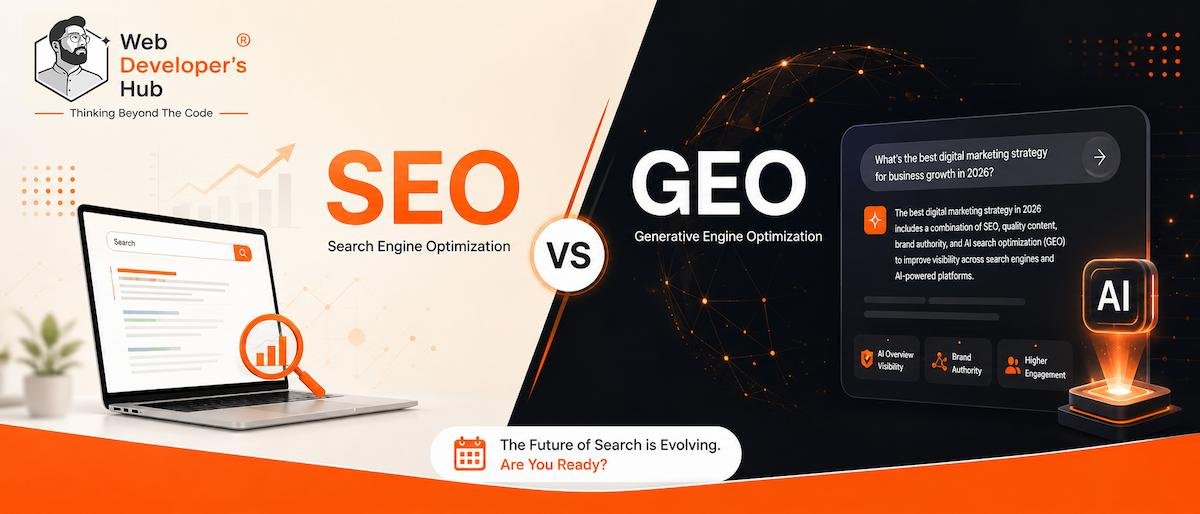
SEO is no longer the whole search visibility story. In 2026, people can discover a business through traditional Google results, AI Overviews, AI Mode and conversational AI tools. That has created a new discipline commonly called Generative Engine Optimization (GEO).
But SEO and GEO are not competing strategies. The strongest approach is to build a technically sound website, publish useful original content and make your business easy for both search engines and AI systems to understand, trust and cite.

SEO vs GEO at a Glance
| SEO | GEO |
|---|---|
| Optimizes visibility in traditional search results | Optimizes visibility in generative AI answers and AI-powered search experiences |
| Focuses heavily on crawling, relevance, rankings and search intent | Focuses on being understandable, useful, trustworthy and citable in generated answers |
| Targets search result pages and organic listings | Targets AI-generated summaries, recommendations and citations |
| Relies on established SEO fundamentals | Builds on SEO fundamentals rather than replacing them |
Google’s current documentation is especially important here: Google says its existing SEO fundamentals continue to apply to generative AI features, while also recommending unique, valuable content and strong page experience.
What Is SEO?
Search Engine Optimization (SEO) is the practice of improving a website so search engines can discover, understand and rank its pages for relevant searches.
For a business website, this includes:
- Technical crawlability and indexability
- Search-intent-focused content
- Useful page titles and descriptions
- Clear heading structure
- Internal linking
- Fast, mobile-friendly pages
- Structured data where appropriate
- Strong topical relevance and authority
- Useful images, videos and other supporting content
These fundamentals still matter in AI-powered search. Google explicitly says websites should continue following SEO best practices when optimizing for its generative AI features.
What Is GEO?
Generative Engine Optimization (GEO) is a broad industry term for improving the likelihood that a brand, page or piece of information is surfaced, mentioned or cited by generative AI search experiences.
Instead of thinking only about ranking at position one, GEO asks a different question:
Can an AI system understand my business well enough to include it when answering a relevant customer’s question?
This can include AI-powered search experiences such as Google’s AI Overviews and AI Mode, as well as conversational assistants and other answer engines.
Why GEO Matters in 2026
Search behavior is changing. Google’s official documentation now includes a dedicated guide for optimizing for generative AI features, and in May 2026 Google announced that its preferred-sources feature was expanding to AI Overviews and AI Mode.
There is also a traffic-side reason to pay attention. Ahrefs’ December 2025 analysis found that when an AI Overview was present, the top-ranking organic result had a 58% lower average click-through rate than comparable searches without an AI Overview. This is a correlation from Ahrefs’ dataset, not a universal prediction for every website or keyword.
That means businesses should think beyond rankings alone. Being visible as a trusted source can matter even when the user does not immediately click a blue link.
Does GEO Replace SEO?
No. This is one of the biggest misconceptions about GEO.
Google’s own guidance says the same SEO fundamentals that help pages perform in traditional search also remain relevant for AI features.
A better model is:
Technical SEO + Helpful Content + Business Authority + Clear Entities + Strong Internal Architecture = Better Search and AI Visibility
What Makes Content More Useful for AI Search?
1. Answer the actual question
AI systems need clear information to work with. Don’t bury the answer under five paragraphs of promotional copy. State the key answer early, then explain the reasoning, examples and exceptions.
2. Create original, non-commodity information
Google’s generative AI guidance specifically highlights the importance of unique, valuable content. Copying the same generic advice found on dozens of other websites gives your page little reason to be selected as a useful source.
3. Demonstrate first-hand expertise
Use practical examples, screenshots, implementation details, original analysis, case studies and clearly explained experience where you genuinely have it.
4. Structure information clearly
Use descriptive headings, short paragraphs, lists, tables and FAQs where they genuinely help readers. A well-structured page is easier for people and machines to understand.
5. Make your business identity clear
Your website should make it obvious who you are, what you do, where you operate and which services you provide. Consistent business information across relevant online properties can reinforce that understanding.
6. Support important claims with trustworthy sources
When discussing statistics, regulations, product specifications or rapidly changing technology, link to authoritative sources and explain the context rather than presenting unsupported claims.
SEO Signals Still Matter for GEO
GEO should not become an excuse to ignore technical SEO.
Your website still needs to be:
- Crawlable
- Indexable
- Mobile-friendly
- Fast enough to provide a good experience
- Accessible to users
- Well organized internally
- Clear about its important topics and entities
For WordPress websites, performance is particularly important. See Why Is My WordPress Website Slow? 15 Causes & How to Fix Them and Core Web Vitals Explained: How Page Speed Affects SEO.
How Internal Linking Supports SEO and AI Visibility
A strong internal-link architecture helps connect related pages into clear topic clusters. For example, a business website can connect its main web-development service to supporting content about website costs, WordPress, performance, e-commerce and redesign.
Your internal links should point to the exact relevant page or article, not simply to a generic blog archive.
For example, our Website Development Cost in Delhi NCR guide explains pricing, while AI Search Optimization focuses specifically on visibility in AI-powered search.
What About Schema Markup?
Structured data can help search engines understand the meaning and relationships of information on a page. It should be implemented accurately and according to the relevant documentation.
However, schema is not a magic GEO switch. Adding unnecessary markup does not guarantee AI citations. The underlying content still needs to be useful, accurate and relevant.
Also note that Google’s FAQ rich-result treatment changed in 2026: Google announced the deprecation of the FAQ rich result feature in May 2026. That does not mean FAQs are useless. Well-written FAQs can still help users understand a topic; they simply should not be created solely because you expect a special FAQ rich result.
How Local Businesses Can Approach GEO
Local businesses have an additional opportunity because customers often ask AI systems questions such as:
- Who is a good website developer near me?
- Which web developer should I hire in Delhi NCR?
- Who builds WordPress websites for small businesses?
- Which agency can redesign my business website?
To improve your chances of being understood and considered, build a consistent local presence around your real business information, services, expertise, customer experience and relevant local content. Do not create fake locations or mass-produce thin location pages.
Recent industry analysis also shows AI Overviews appearing frequently for local searches, making local AI visibility an increasingly relevant extension of local SEO.
A Practical SEO + GEO Checklist for 2026
- Make sure important pages can be crawled and indexed.
- Write for a specific search intent instead of a vague keyword.
- Answer important questions directly and accurately.
- Publish original information, examples or analysis.
- Build clear topic clusters with contextual internal links.
- Use descriptive titles and headings.
- Keep business name, services and location information consistent.
- Use appropriate structured data without abusing it.
- Improve page speed and mobile usability.
- Build genuine authority through useful work, reputation, mentions and references.
- Monitor both traditional organic performance and emerging AI visibility where data is available.
What Businesses Should Do Next
If your website already has a solid SEO foundation, you do not need to rebuild everything because of GEO.
Instead, audit your existing content and ask:
- Does this page answer a real customer question?
- Is the answer clear within the first part of the article?
- Does the page contain original value?
- Are related pages connected through exact, contextual internal links?
- Is our business identity and expertise clear?
- Are important facts supported by trustworthy sources?
- Is the website technically healthy?
This approach improves the underlying website rather than chasing every new AI-search acronym.
SEO vs GEO: The Bottom Line
SEO helps your website become discoverable and competitive in search. GEO focuses on making your information useful and understandable enough to be surfaced in generative answers.
In 2026, the smartest strategy is not SEO versus GEO. It is SEO plus a stronger content and authority architecture designed for a search environment where answers may be generated before a user visits a website.
For businesses, that means investing in a fast, technically sound website, publishing genuinely useful content, building topical authority and making your expertise easy to understand.
Web Developer’s Hub helps businesses build SEO-friendly WordPress and custom websites with strong content architecture, performance and conversion-focused UX.