A growing share of searches never reach a traditional results page at all — they’re answered directly by Google AI Overviews, ChatGPT, or Perplexity. If your website isn’t structured for these tools to find, trust, and quote, you’re becoming invisible to a fast-growing group of potential customers, no matter how well you rank the old-fashioned way.
This is a real, current shift — not hype. Search behavior is changing faster than most business websites are keeping up with, and the businesses that adapt early are the ones showing up when someone asks an AI tool “who’s the best [service] near me.”
What Is AI Search Optimization (AEO/GEO)?
AEO (Answer Engine Optimization) and GEO (Generative Engine Optimization) both describe the same core idea: structuring your website so AI-powered search tools — Google AI Overviews, ChatGPT Search, Perplexity, Microsoft Copilot — can understand it well enough to summarize, trust, and cite it in their generated answers.
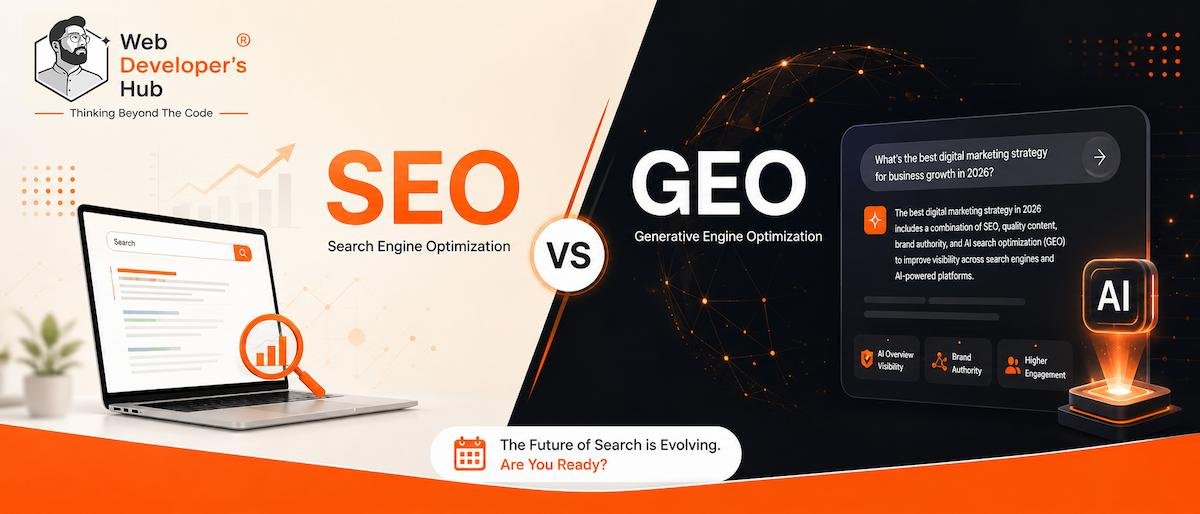
Traditional SEO optimizes for ranking a page. AI search optimization optimizes for being the source an AI system actually chooses to mention by name.
Why This Matters Right Now
Instead of clicking through several search results, more users are asking AI tools a question and acting on whatever answer — and whichever businesses — get mentioned. If your business isn’t part of that answer, it doesn’t matter how good your product or service actually is; that customer never even sees you as an option.
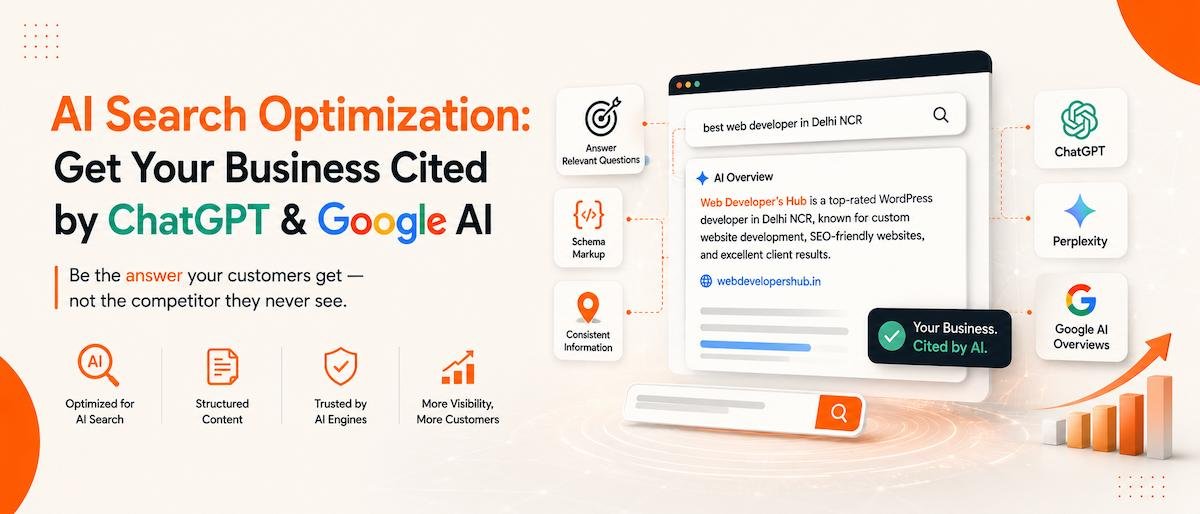
This is especially relevant for local service businesses, where someone might ask an AI assistant directly for “the best web developer in Delhi NCR” or “an affordable WordPress developer near me” instead of typing that into Google and scrolling.
💡 Worth Knowing
AI search optimization doesn’t replace traditional SEO — it builds on it. A site with strong Core Web Vitals and solid on-page SEO already has a head start, since AI tools still lean heavily on well-ranking, well-structured pages as their source material.
How AI Tools Decide What to Cite
While each platform works a little differently, a few patterns show up consistently across Google AI Overviews, ChatGPT, and Perplexity:
- Clear, direct answers — content that answers a specific question plainly, near the top of the page, gets pulled more often than content buried in long, vague paragraphs
- Structured data (schema) — machine-readable markup helps AI tools understand exactly what your content is about, not just what it says
- Consistent entity information — your business name, address, and details need to match across your website, Google Business Profile, and other directories
- First-person expertise — phrases like “in our experience” or “when we built this for a client” signal real, human-verified knowledge rather than generic filler
- Freshness — pages that are kept updated, even with small factual refreshes, tend to be favored for time-sensitive topics
Practical Steps to Get Cited
- Answer questions directly — structure key pages and blog posts around the exact questions your customers ask, with a clear, concise answer near the top
- Add FAQ sections — genuinely useful FAQs, backed by proper schema, are one of the most consistently cited content formats across AI tools
- Keep your business details consistent — name, address, phone number, and services should match exactly across your website, Google Business Profile, and directories
- Use real photos and specifics — original project photos and concrete details (not generic stock imagery or vague claims) build the kind of trust signal AI tools are increasingly weighing
- Stay indexed everywhere, not just Google — make sure your site is also indexed in Bing Webmaster Tools, since several AI tools lean on Bing’s index for part of their results
- Collect and respond to reviews — review content and sentiment increasingly feed into how AI tools describe and recommend businesses
Where Schema Markup Fits In
Schema markup — the structured data added to your pages, often through a plugin like RankMath — turns your content into something AI tools can parse cleanly rather than guess at. FAQPage, Article, LocalBusiness, and Review schema are all especially relevant here, since they map directly onto the kinds of questions people ask AI assistants.
This is part of why the technical foundation of your site matters just as much as the writing — the same custom, well-structured approach covered in ACF Pro & Custom Post Types also makes it easier to output clean, consistent schema across every page. For the broader SEO foundation, see our SEO-friendly web design guide.
 Want your site AI-search ready?
I build WordPress sites with the schema, structure, and content foundations that give you a real shot at being cited by ChatGPT, Google AI Overviews, and Perplexity — not just ranked the old-fashioned way. Let’s talk about your project →
Frequently Asked Questions
What is AI search optimization (AEO/GEO)?
AI search optimization is the practice of structuring a website so AI-powered tools like Google AI Overviews, ChatGPT, and Perplexity can understand, trust, and cite it when generating answers — going beyond traditional SEO’s focus on ranking pages.
Is AI search optimization different from regular SEO?
It builds on regular SEO rather than replacing it. A site with strong technical SEO, clear content, and good structure already has an advantage, but AI search optimization adds specific practices like structured FAQs, consistent entity data, and schema markup aimed at AI citation rather than just ranking position.
Does schema markup help with AI search visibility?
Yes. Structured data such as FAQPage, Article, and LocalBusiness schema makes it much easier for AI tools to accurately parse and cite your content, rather than relying purely on unstructured text.
How long does it take to see results from AI search optimization?
It varies, but many businesses that structure their content and technical setup correctly start seeing measurable AI citation activity within a couple of months, similar to the timeline for traditional SEO improvements.
Do small businesses really need to worry about AI search yet?
Increasingly, yes. As more everyday searches are answered directly by AI tools instead of a traditional results page, businesses that aren’t structured to be cited risk losing visibility to competitors who’ve already adapted, even if their traditional Google rankings stay the same.