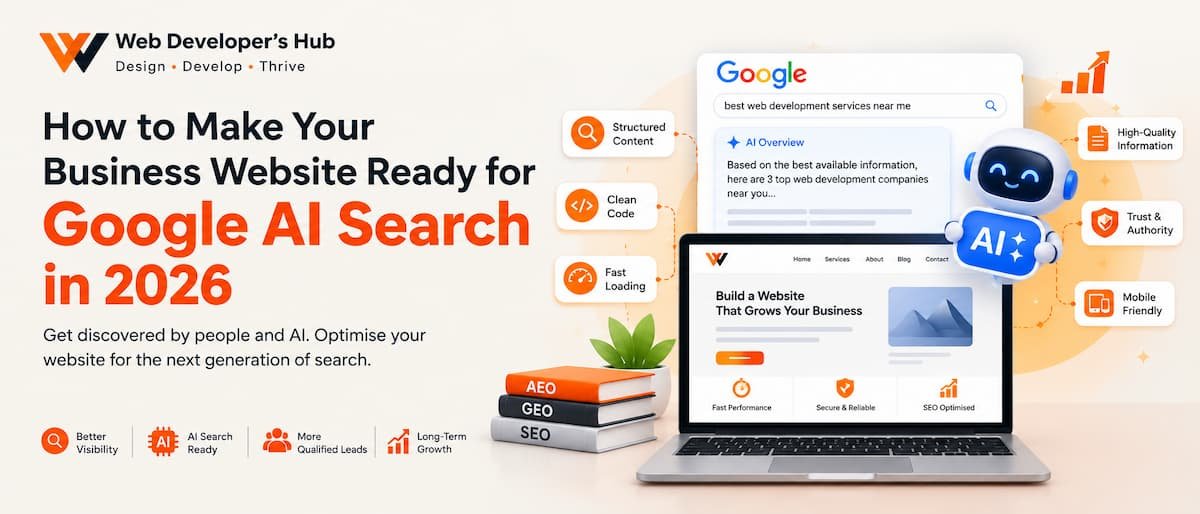
The way people search for businesses is changing faster than most websites are keeping up with. Google Search now includes AI-powered experiences such as AI Overviews and AI Mode, which can answer complex questions while also directing people to relevant websites and sources. Google says AI Overviews now reach more than 2.5 billion monthly active users and AI Mode has surpassed 1 billion monthly users, making AI search visibility increasingly important for businesses that depend on organic discovery.
None of this is a reason to panic. It’s a reason to make sure your website is genuinely ready. This guide walks through what’s actually changed, what still matters, and the practical steps a small or local business can take — without chasing hype or trying to “trick” an algorithm that’s explicitly designed to catch exactly that.
What Is Google AI Search?
“Google AI Search” isn’t one single feature — it’s a few related experiences:
- AI Overviews — AI-generated summaries that appear above traditional search results for many queries, pulling information from multiple sources.
- AI Mode — a fuller, conversational search experience where Google answers longer, more detailed questions directly, often citing a handful of sources it trusts.
The key thing to understand is that these AI experiences still rely on the same underlying web content that traditional Search does. Google’s own reporting confirms it has expanded the pool of sources it draws from for AI Overviews, and pages that already rank well and are well-structured are the ones most likely to be pulled into an AI-generated answer. In other words, your website hasn’t become irrelevant — it’s become the raw material that AI search is built on.
Does Traditional SEO Still Matter in AI Search?
Yes — and this is the single most important thing to understand before doing anything else. Traditional SEO isn’t being replaced by “AI SEO.” It’s the foundation AI search sits on top of.
Google still needs to be able to:
- Crawl your site (find your pages)
- Index your pages (store and understand them)
- Rank them for relevant queries
If any of those three break down, it doesn’t matter how “AI-ready” your content is — Google’s systems, human or generative, will never see it. That means the fundamentals haven’t gone anywhere:
- Clean, logical site structure and internal links
- Genuinely useful content that matches what people are searching for
- Fast-loading, mobile-friendly pages
- Accurate, up-to-date business information
- A technically clean site free of broken links, duplicate content, and crawl errors
If your site is weak on these basics, fix them first. Everything else in this guide builds on top of them.
10 Ways to Make Your Business Website Ready for AI Search
1. Publish genuinely useful content
Write content that answers real questions your customers ask — not content written purely because a keyword tool flagged it. AI systems, like human readers, favor pages that clearly and directly solve a problem.
2. Answer specific questions directly
Structure key pages and blog posts so the direct answer appears early and clearly, rather than being buried under several paragraphs of preamble. This helps both human visitors who are skimming and AI systems that are summarizing.
3. Make important business information easy to find
Your services, pricing approach, location, and contact details should be clear and consistent — not scattered across the site or hidden in a PDF. Consistency across your website, Google Business Profile, and directories also matters (we go deeper on this in our dedicated guide to getting cited by ChatGPT and Google AI).
4. Build genuine topical relevance
Rather than one page trying to cover everything, build a cluster of focused pages — one per core service, one per meaningful location — that link to each other. This helps search engines understand the full depth of what you do.
5. Improve internal linking
Every important page on your site should be reachable within a few clicks from your homepage, and related pages should link to one another naturally. Weak internal linking is one of the most common (and most fixable) problems on small business websites.
6. Keep your site structure technically clean
Avoid duplicate pages, broken links, and confusing URL structures. A simple sitemap, clear navigation, and consistent URL patterns make it far easier for Google to crawl and understand your entire site.
7. Improve mobile experience and site speed
Slow, clunky mobile pages hurt rankings and drive visitors away before they ever read your content. If you’re not sure where your site stands, our breakdown of why WordPress sites slow down and how to fix it and our explainer on Core Web Vitals and page speed are good places to start.
8. Strengthen local SEO signals
For local and service-area businesses, an optimized Google Business Profile, consistent name-address-phone details, and genuine customer reviews all feed into how both traditional and AI-powered search describe your business.
9. Demonstrate real expertise and experience
Original photos, specific project details, and first-hand language (“in our experience,” “when we built this for a client”) signal authenticity — something both human readers and Google’s quality systems are increasingly designed to reward over generic, interchangeable text.
10. Keep content updated
A page that’s accurate today can go stale in a year. Revisiting older content, correcting outdated details, and adding new information keeps both your rankings and your AI-search visibility from quietly decaying.
What AI Search Optimization Is NOT
It’s worth being direct about this, because a lot of bad advice is circulating. AI search readiness does not mean:
- Stuffing pages with “AI,” “2026,” or other trending keywords
- Mass-publishing large volumes of AI-generated articles with no editorial review
- Copying competitors’ content structure or wording
- Writing content aimed purely at algorithms rather than actual readers
- Trying to manipulate or “trick” AI systems into citing your site
Google has been explicit that its spam policies apply here just as they do everywhere else. Its scaled content abuse policy targets any site — regardless of whether the content is written by a person or generated by AI — that publishes many pages primarily to manipulate rankings rather than genuinely help users. The safest long-term strategy has always been the same one: create pages that deserve to exist because they’re useful, not because they contain a keyword.
How to Structure a Business Website for Better Search Visibility
A common mistake on small business sites is cramming every service onto a single page. A clearer structure — and one that’s easier for both users and search engines to navigate — usually looks like this:
Home → Services → Individual Service Pages → Location/Service Area Pages (where genuinely useful) → Blog/Resources → About → Contact
Dedicated service pages let you go deeper on each offering, target the specific questions customers ask about that service, and give search engines a clear signal about exactly what you do — rather than one generic page trying to rank for everything at once.
Why Your Website Content Matters More Than Ever
Whether a human visitor or an AI system is “reading” your site, they’re both looking for the same things: clarity on what you do, who you help, where you operate, what you charge (or how pricing works), why they should trust you, and how to get in touch. A site that answers these questions clearly on its core pages will consistently outperform one that makes visitors dig for the basics — in traditional rankings and in AI-generated answers alike.
A Simple AI Search Readiness Checklist
- [ ] Site loads quickly on mobile devices
- [ ] Core Web Vitals are in good standing
- [ ] Every key page is reachable within a few clicks of the homepage
- [ ] Services have their own dedicated pages, not one combined page
- [ ] Business name, address, and phone number match everywhere online
- [ ] Content answers specific customer questions directly and early
- [ ] No broken links, duplicate pages, or obvious crawl errors
- [ ] Site has a clean XML sitemap submitted to Google Search Console
- [ ] Content includes real examples, photos, or first-hand details
- [ ] Older pages are reviewed and refreshed periodically
- [ ] Google Business Profile is complete and consistent with the website
- [ ] Genuine customer reviews are visible and current
- [ ] No content exists purely to target a keyword with no real value
Should You Redesign Your Website for AI Search?
Not necessarily. The existence of AI search isn’t, by itself, a reason to tear down a website that’s otherwise working. A full redesign makes more sense when your current site is genuinely holding you back — for example, if it:
- Is outdated or difficult to navigate
- Performs poorly on mobile or loads slowly
- Has weak or missing dedicated service pages
- Has poor or nonexistent internal linking
- Doesn’t clearly communicate what you do or who you serve
- Has ongoing technical SEO problems
- Simply isn’t generating enquiries anymore
If several of these sound familiar, a redesign focused on the fundamentals of a professional website will do far more for your visibility — in AI search and traditional search alike — than trying to patch an outdated site with quick fixes. And if you’re weighing a full rebuild against smaller structural fixes, our guide on when and how to redesign a website walks through how to make that call.
Frequently Asked Questions About Google AI Search
Does SEO still matter for Google AI Search?
Yes. Google AI Search still relies on the web and its core Search systems. Strong technical SEO, useful content, clear site structure, internal links, and a good page experience remain important foundations for visibility.
How can a small business appear in Google AI Overviews?
There is no guaranteed method or special “AI Overview ranking” switch. Focus on being a strong, crawlable and trustworthy source: publish original information, answer customer questions clearly, build relevant service content, maintain accurate business information, and keep your site technically healthy.
Does Google require special AI SEO markup?
No special markup guarantees inclusion in AI Overviews or AI Mode. Use appropriate structured data where it genuinely describes the page, but prioritize accessible content, strong site architecture, helpful information, and standard technical SEO.
Should I publish more AI-generated content to get cited?
No. Publishing large volumes of low-value content simply to manipulate search visibility is a poor strategy. Use AI as a productivity tool if appropriate, but make sure the final content is accurate, useful, original, and meaningfully edited.
Is Google AI Search available in India?
Yes. Google began rolling out AI Mode in India in 2025, and Google’s 2026 updates show that AI Overviews and AI Mode are continuing to expand and evolve. Availability and features can vary by account, query, device, language, and market.
Conclusion
AI search isn’t something to game — it’s something to be genuinely ready for. The businesses that show up in AI Overviews and AI Mode answers aren’t the ones with the most keywords; they’re the ones with fast, clean, well-structured websites that clearly explain what they do and back it up with real substance. Build a site that’s useful, technically sound, mobile-friendly, and easy to understand, and you’ll be well positioned for however search continues to evolve.
If your current website is missing several of the basics above, or you’re simply not sure where it stands, get in touch — a technical and content audit is usually the fastest way to find out exactly what’s holding your visibility back.